
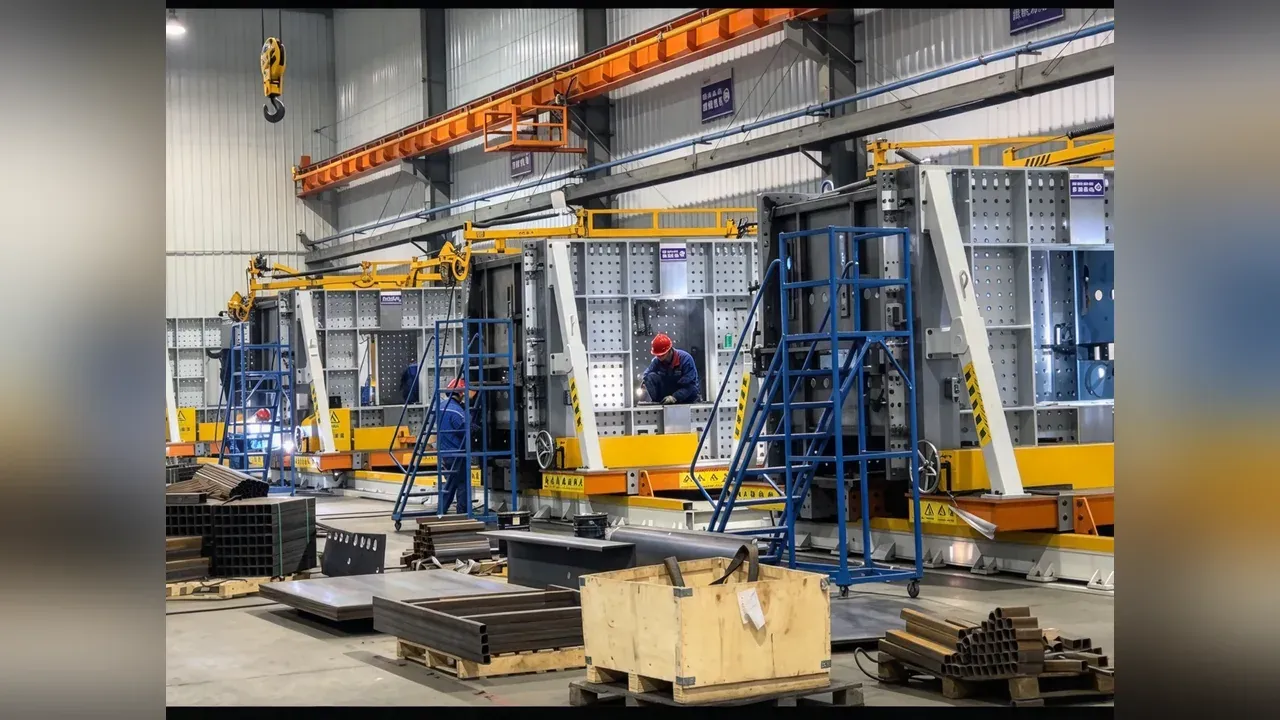
Flexible automation starts with a defined manufacturing task
SANWZB's supplied company archive discusses the transition from manual production toward automated welding and flexible fixture systems. The archived article includes historical market commentary and describes the company's work in welding process equipment and fixture integration. Its webpage carries a publication date of 21 November 2023, while some of the market examples are older. This English article preserves that context and focuses on practical questions for a present-day equipment inquiry, without presenting historical market figures as current data.
Describe the manufacturing problem clearly
An automation discussion should begin with the assembly and the work that needs to be done. Record which activities are difficult to reproduce, which part variants share a station and where the production team encounters access or handling constraints. A request to automate welding can refer to several different tasks. Separating preparation, loading, positioning, joining and unloading makes the intended scope easier to understand.
Use the existing process as a factual starting point. A drawing identifies the part, but a process description explains how it moves through the workshop. Include the current sequence, the equipment that must remain and the responsibilities that the new arrangement is expected to take on. This does not require a promised return on investment. It requires enough information to discuss a workable technical boundary and the interfaces around it.
Treat the workpiece family as an engineering input
Flexible equipment is often considered when more than one assembly needs to use the same production resources. List those assemblies and identify their meaningful differences. Overall dimensions, locating features and the position of joints may vary independently. A group of visually similar products is not necessarily one straightforward fixture family. The supplier needs the relevant drawings to understand which features can share a reference arrangement.
Also identify how often the product mix changes and which variants are important for the first release. A project can become difficult to define if every possible future component is treated as a confirmed requirement. Distinguish the initial scope from potential expansion. That gives the engineering team a basis for discussing standard components, dedicated tooling and the parts of the installation that may need to change later.
Keep locating and clamping in the automation scope
A robot or automatic machine does not remove the need to present the assembly in the intended position. The workholding arrangement should identify the references that establish that position and the clamps that hold the components against them. These are different functions. Reviewing them separately can make it easier to discuss changes in part geometry, operator access and the intended sequence.
Send the relevant datum information and dimensional requirements with the inquiry. If the proposed fixture connects to an existing table, positioner or cell, include its interface drawings. A modular system may provide reusable components, but their suitability needs to be confirmed for the selected arrangement. Neither an automated process nor a table family name is a substitute for a technical review of the actual component and fixture layout.
Review the complete operating envelope
The space occupied by the assembly is only part of the layout. Loading devices, tooling, clamps, surrounding equipment and the intended movements also need consideration. The integrator should receive information about these constraints before the fixture is finalized. A static image may show a part in position without demonstrating that the proposed loading and unloading movements are practical.
For a robotic application, discuss the access required by the joining equipment and the relevant interfaces with the responsible integrator. Clarify who provides each element and who reviews the combined arrangement. Do not assume that purchasing a flexible platform includes robot programming, cell guarding or every integration task. The quotation should identify the supplied equipment and services so that responsibility for the complete installation remains understandable.
Plan the change between products
Flexibility needs a usable changeover method. Identify the components that stay in place, those that move and those that are exchanged when the assembly changes. Review how each arrangement is identified and checked before production resumes. A system that can theoretically be rebuilt still needs a practical way for the production team to reproduce the correct setup.
Document the layouts and their component lists. Associate each with the applicable part revision and any installation instructions. If dedicated inserts or custom elements are required, distinguish them from the reusable standard inventory. This makes the proposed flexibility specific enough to assess. It also avoids treating an undefined future rearrangement as a benefit that has already been demonstrated for the buyer's production conditions.
Include people and technical support
The historical SANWZB article emphasizes that equipment changes also require attention to operator capability, maintenance and technical personnel. That remains a useful planning principle without relying on its dated market statistics. The project team should identify who will operate the installation, change fixtures, maintain equipment and resolve production questions. Those responsibilities influence the documents and product instruction needed at handover.
SANWZB's supplied FAQ describes manuals, operation videos and remote training that can be discussed for relevant products. Ask for the support applicable to the selected system and agree on its scope. Product instruction is distinct from a complete training program for an automated cell. If multiple suppliers are involved, clarify which team addresses each interface and how the operating documentation is coordinated.
Choose a manageable first application
A proposed automation project benefits from a clearly defined initial task. The buyer can select an assembly or group of assemblies that represents the intended requirements and has sufficiently complete technical information. This is a project planning choice rather than a universal recommendation to automate a particular product first. The purpose is to make the scope concrete enough for engineering discussion and acceptance planning.
Identify the conditions under which the arrangement will be evaluated. Include the agreed parts, fixtures, operating sequence and responsible personnel. If later expansion is anticipated, record it separately. A project-specific review can then discuss how that possibility affects the initial equipment. Keeping confirmed and potential requirements separate helps prevent a quotation from appearing to include capabilities that have not actually been specified.
Evaluate outcomes with a defined baseline
Historical promotional statements are not a reliable forecast of results for another factory. If the buyer expects improvements in consistency, changeover or process organization, define how those outcomes will be assessed. Identify the existing method and the proposed task under comparable conditions. Avoid combining unrelated operations into a single number that makes the comparison difficult to interpret.
Any target should be distinguished from an accepted contractual requirement and from an observed result. The fact that a layout is modular does not establish a particular time saving. Likewise, a company reference does not prove performance on a different assembly. An evaluation becomes more useful when the team documents the actual conditions, the measurement method and the evidence needed to support its conclusion.
Agree on the inspection and handover scope
The fixture and associated equipment should be reviewed against the requirements agreed for the project. Ask which drawings, component lists and inspection documents will be provided. Clarify whether any application testing or installation assistance is included. These details should be settled before production or shipment, especially when the tooling becomes part of equipment supplied by another company.
At handover, retain the applicable revisions and identify the installed configuration. If a later product change affects the locating references or equipment access, review the arrangement again rather than assuming that the original approval remains sufficient. This is one reason to keep the fixture documentation accessible to engineering and production personnel. The equipment and the records should describe the same physical arrangement throughout its intended use.
Separate equipment selection from commercial assumptions
The technical solution, delivery schedule and commercial terms need their own confirmations. SANWZB's supplied FAQ discusses several trade terms and payment methods, but the actual choices depend on the quotation. Similarly, a general production lead-time reference does not establish the schedule for a custom integrated project. Request the timing and included responsibilities for the defined scope.
For an international order, identify the destination, packaging requirements and any documents needed for receipt or customs. Ask whether the quotation covers only the fixture equipment or also other project elements. Clear commercial boundaries help the buyer coordinate transport, installation and the work of other suppliers. They also reduce the risk of interpreting a broad company capability statement as a commitment for the particular order.
Prepare an automation-focused inquiry
Send drawings, assembly dimensions, materials, quantities and the part variants that form the initial scope. Add a description of the current process, the proposed automated operation and the equipment interfaces. Identify the required documentation, acceptance criteria and responsibilities that you want the quotation to address. If drawings are confidential, discuss an NDA before sharing the technical package.
Contact [email protected] to begin the review. The custom fixture and manufacturing capability pages provide further information about SANWZB's supplied company scope. This article draws on the historical company discussion of flexible automation while keeping present-day decisions tied to current drawings and a project-specific quotation. It does not claim a guaranteed productivity result or transfer historical third-party relationships into a current integration agreement.
Source and related resources
Based on the supplied SANWZB company archive: Original company article 453. Historical website publication dates are kept separate from the events discussed.
System selection guide · Custom fixture requirements · Discuss your project