
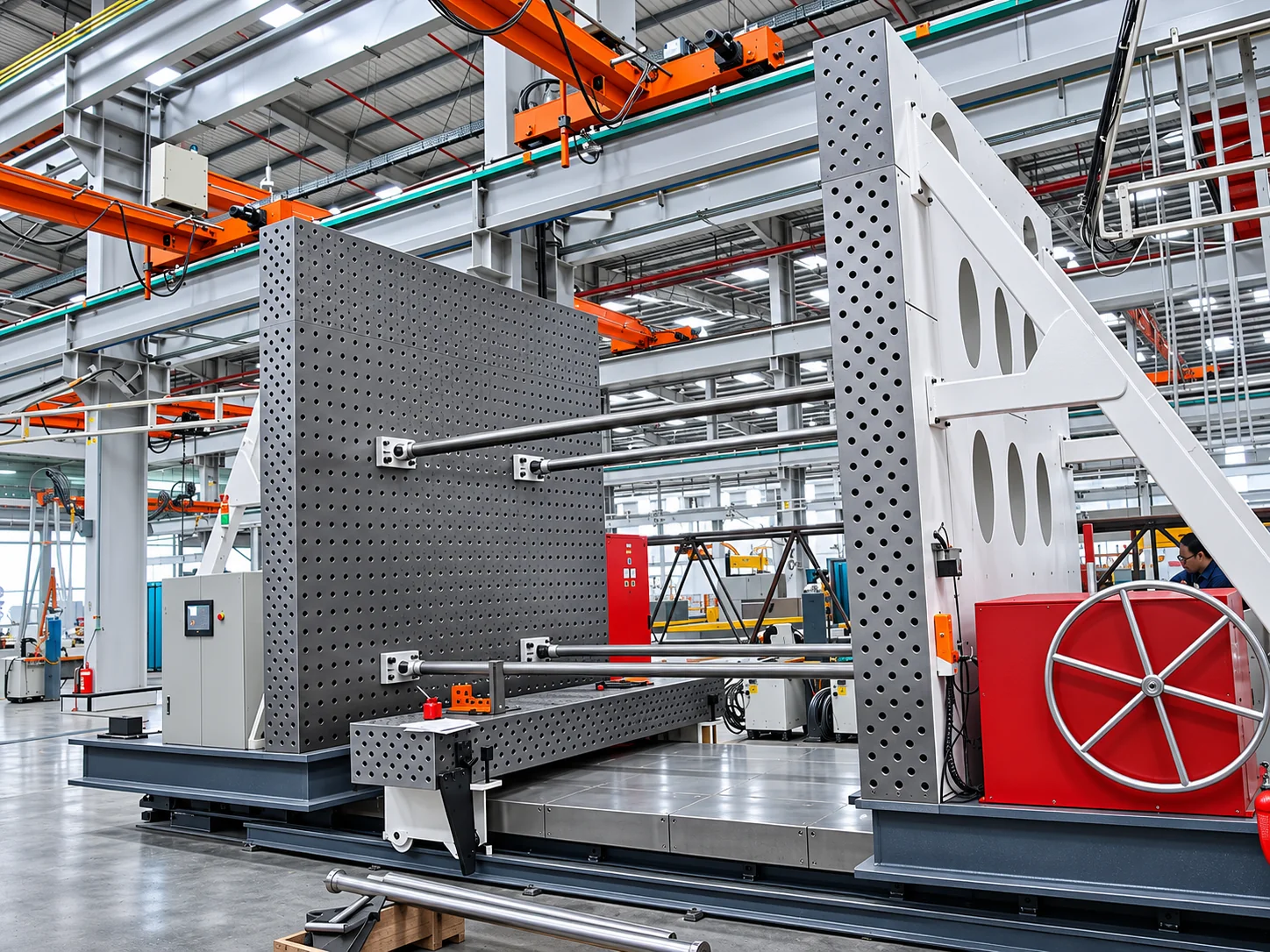
Start with the workpiece
List the maximum part dimensions, material, weight, critical references and welding access requirements. Consider how the assembly will be loaded, supported, rotated if relevant, and removed. These requirements determine the useful work area and tooling arrangement.
D16, D22 and D28 system selection
The catalog groups tables by bore system. Select a compatible table and accessory family, and verify the dimensions of every locating pin, bolt and fixture interface. Do not assume that different bore systems or another manufacturer's accessories are interchangeable. Confirm compatibility using the product specifications or a drawing review.
2D and 3D table formats
Compare the working surfaces and locating directions available on the actual model. A tabletop arrangement and a table with additional working faces offer different layout possibilities. The best format depends on the assembly geometry and access, rather than the product name alone.
Materials and surface treatments
The catalog includes steel and SUS304 models, as well as specified nitrided and black oxide variants. Review the individual product description to confirm the material and treatment supplied. Suitability for a particular environment and the care procedure should be agreed for the selected model.
Plan the accessory set
Map the locating points, supports, stops and clamps to the assembly drawing. Count repeated stations and consider clearance around joints. A fixturing kit can be a starting point, but its components should be checked against the task instead of assuming that every application is covered.
Check the quotation before ordering
Confirm the table dimensions, support structure, accessory quantities, any custom parts, drawing revision and inspection requirements. State the destination and proposed trade term. If you are replacing or extending an existing setup, send its interface details so that compatibility can be reviewed.
Verify the bore grid and order reference
Check bore diameter, hole spacing, usable working surfaces and the table dimensions in the selected model specifications. The grid determines where compatible locating and clamping elements can be positioned. Copy the complete model and order code from the product specification when requesting a quotation; ask our team to confirm any code or suffix whose meaning is unclear. Do not infer dimensions or included accessories from a code alone.
Discuss your welding project
Send your drawings, workpiece dimensions, material and quantity. Our team will review the requirements with you.
Discuss Your Project[email protected]