
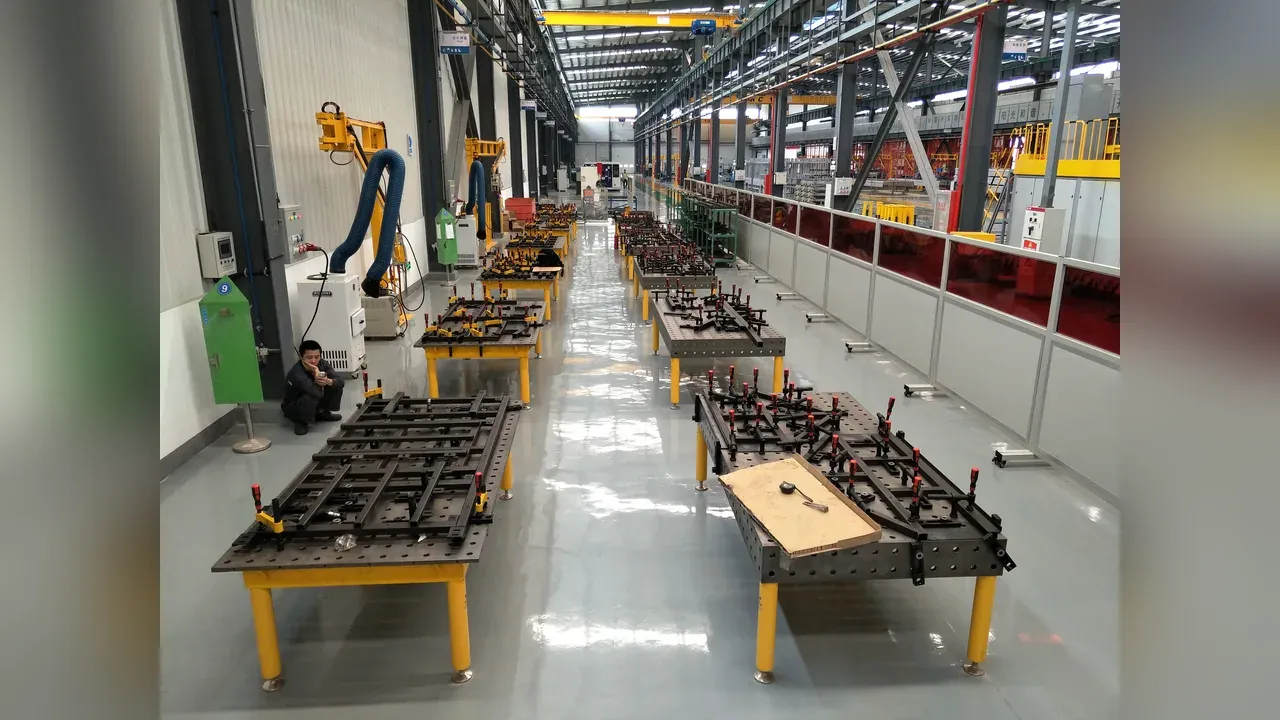
Flexible welding platforms for robotic applications
A robotic welding platform belongs to a larger arrangement of workpiece, fixture, joining equipment and operating sequence. SANWZB's supplied technical archive discusses modular platforms as a way to organize workholding for different assemblies. This article develops that topic into a buyer's review guide. It does not assign a universal tolerance, capacity or productivity result to the complete catalog. The selected model, fixture layout and integration scope must be confirmed for the actual application.
Begin with the part presentation task
The first question is how the assembly is presented to the joining equipment. Provide the part and assembly drawings, the important locating features and the intended sequence. Identify the components that must be supported before the first joining operation and the areas that need access afterward. This information makes it possible to discuss the fixture as part of the process rather than as an isolated table.
Also describe the incoming condition of the components. The fixture review needs to consider what is being located, rather than assuming that every incoming piece has exactly the same geometry. Any required control of variation should be addressed through the agreed technical review. A modular interface offers ways to arrange components, but it does not replace a defined approach to incoming parts and assembly requirements.
Distinguish the table from the complete cell
A table can provide the base and working interfaces for a fixture. A complete robotic cell may involve additional equipment, controls, programming, handling and protective arrangements. These elements should have clearly assigned owners. Ask the quotation to identify what SANWZB supplies and what remains with the integrator or buyer. Broad descriptions of robotic applications should not be interpreted as an unlimited integration commitment.
Share the relevant interface drawings with the parties responsible for the combined installation. Where a fixture connects to a positioner or another supporting device, confirm the physical connection and application requirements. A photograph of a similar installation cannot establish that the new arrangement fits. The review should use the actual equipment dimensions and the technical information supplied by the responsible equipment manufacturers.
Select the working format deliberately
SANWZB's catalog includes 2D, 3D and specified robotic table options. Compare their actual working faces, dimensions and interfaces against the assembly. Some parts may benefit from locating elements arranged on more than one face, while others need an open area around a single working surface. The right selection depends on the process and access requirements rather than a general ranking of formats.
Do not assume that a product called a robotic welding table is compatible with every robot or positioner. Ask what the selected model provides and what must be designed separately. If the platform is intended to move with other equipment, identify that requirement early. The responsible engineering team needs the complete arrangement to review the interfaces, not just the catalog name of the table.
Confirm the fixture system family
The table and its accessories need compatible locating and locking interfaces. Identify whether the proposed arrangement uses D16, D22 or D28 components, then verify the specifications of the selected items. Similar appearance is not enough to establish interchangeability. Existing fixtures, adapters and custom parts should be included in the review wherever they affect the planned system.
Prepare the accessory list from the fixture layout. Identify the locating elements, supports and clamps that are required at the same time, together with their quantities. Distinguish reusable standard components from dedicated tooling. This makes the quotation easier to assess and gives the installation team a defined list of parts. It also helps prevent optional accessories from being mistaken for items included with the base table.
Review access through the intended sequence
A static layout shows one condition of an assembly. The actual process includes placing components, closing clamps, reaching the joints and removing the finished part. Review those conditions separately with the responsible integrator. A clamp that is convenient during loading may obstruct a later operation. A support that appears accessible in a drawing may need another arrangement when the surrounding equipment is included.
Provide the sequence and relevant movement information before the layout is finalized. The objective is to identify questions that need engineering review, rather than to claim that a general diagram proves the arrangement workable. Any simulation or application testing should be described in the project scope, including who performs it and what information it uses. Keep its results associated with the reviewed revision.
Account for loading and removal
Specify whether components are loaded manually or with other handling equipment. Include the direction of approach and the space needed around the assembly. Explain how the part is removed after the joining operation and whether any fixture components must open or move. These details can influence the layout as much as the location of the welds themselves.
When discussing the platform, identify practical constraints in the existing workshop. The supplier should know about nearby equipment and the interfaces that must remain. Handling responsibilities and any lifting arrangement need their own review for the actual installation. This article does not provide a handling design or a universal load assessment. Those requirements must be addressed using the selected equipment specifications and a project-specific engineering process.
Plan product changeovers
A flexible platform may be considered for several assembly variants. List those variants and show which locating features remain common. Identify what changes between layouts: a support position, a dedicated insert, a complete fixture assembly or the table arrangement itself. A clear changeover concept is more useful than an undefined statement that the system can accommodate different products.
Associate every configuration with its component list and applicable part revision. Decide how operators identify the correct layout and what must be checked after a change. If the integrator needs signals or other confirmation from the fixture, discuss that requirement explicitly. Do not assume that the mechanical modular system automatically includes every control or verification function needed by the wider cell.
Keep process assumptions visible
The joining process, sequence and part condition affect the requirements placed on the fixture. Share those assumptions with the team reviewing the arrangement. When the process changes, revisit the relevant access and workholding questions. A fixture accepted for one operation should not automatically be treated as approved for a different operation simply because the outer dimensions of the assembly remain similar.
Where a project has specific acceptance criteria, include them in the inquiry. The table's product specification and the performance of the completed assembly are related but distinct matters. Define which characteristics are being reviewed and how they will be checked. Avoid transferring a general statement about platform accuracy into a guarantee for every finished weldment without the necessary project agreement and evidence.
Define documentation and inspection
Ask for the drawings, component identification and product documentation relevant to the selected platform. Identify any inspection records required by the buyer. A useful handover package should allow the responsible team to understand what was supplied and which configuration was reviewed. Any additional application testing or commissioning assistance should be described separately in the quotation.
Retain the applicable revisions when the equipment is installed. If custom fixture elements are changed later, update the records so that they continue to describe the physical arrangement. This supports more precise communication between production personnel, maintenance staff and the supplier. It also makes a later support inquiry easier to investigate because the model, interfaces and relevant changes can be identified.
Review maintenance and support needs
Request the care instructions for the actual material, surface treatment and components supplied. Keep the relevant equipment identification available for support questions. The needs of a robotic installation may involve several suppliers, so identify which team addresses the platform, the custom fixture and the surrounding cell equipment. General product support should not be confused with responsibility for every part of the installation.
SANWZB's supplied FAQ describes manuals, operating videos and remote training that can be discussed for relevant products. Explain which tasks your team needs to understand. Agree on the applicable support rather than assuming a particular duration or response commitment. For a quality question, provide the order reference, photographs and a description of the observed condition to [email protected].
Evaluate flexibility without assuming a result
Reusable components can be part of a planned approach to different assemblies, but they do not establish a guaranteed time saving or financial return. Define the current method and the proposed comparison before evaluating benefits. A changeover estimate should identify the actual steps and equipment involved. A company archive or another customer's application does not provide that evidence for the buyer's own process.
Separate expected outcomes, acceptance requirements and measured results in the project records. This makes the evaluation more transparent and allows the team to identify what remains uncertain. Where a proposed arrangement has not yet been tested, describe it as a proposal. The purchase discussion can then focus on the information and checks needed to reach a supported decision.
Send an integration-ready RFQ
Include assembly drawings, workpiece dimensions, material, quantity and relevant variants. Provide the table or positioner interfaces, the intended operating sequence and the access constraints of the cell. Identify who owns the integration tasks and which documents or acceptance activities you want the quotation to include. Discuss an NDA before sharing confidential technical information where necessary.
Email [email protected] to review the appropriate table system and fixture scope. The robotic table collection, custom fixture page and technical support information provide related starting points. This article is based on SANWZB's supplied technical material about robotic flexible platforms, with its historical promotional claims kept separate from current product specifications and the requirements of a new integrated installation.
Source and related resources
Based on the supplied SANWZB company archive: Original company article 448. Historical website publication dates are kept separate from the events discussed.
System selection guide · Custom fixture requirements · Discuss your project